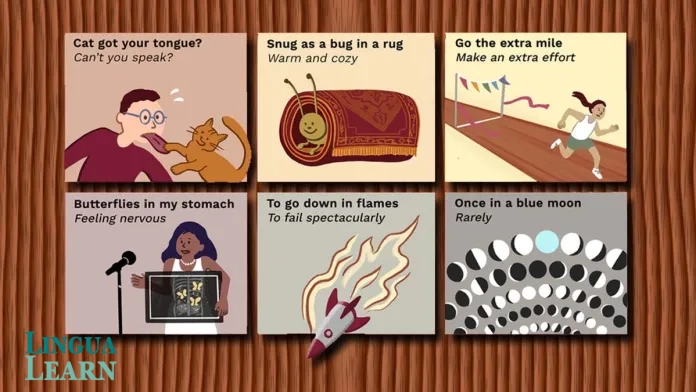
Ever heard a native speaker say “it’s a piece of cake” and wondered where the cake was? That is an idiom. English idioms are expressions whose meaning differs from the words that make them up, and you will run into them in conversations and films.
The literal translation of “piece of cake” is a slice of dessert, while the meaning is something very easy. That is why idioms are hard to guess and worth learning as a package. Here are ten common ones with meanings and example sentences, so your conversations sound more natural.
See also: Effective Ways to Learn English for Beginners: A Complete Guide from Scratch
The five idioms below come up often in meetings and office chat.
| Idiom | Meaning | Example |
|---|---|---|
| Call it a day | To stop working for the day | “It’s late, so let’s call it a day.” |
| Get the ball rolling | To start something | “Let’s get the ball rolling with the first agenda.” |
| On the same page | Sharing the same understanding | “Before the meeting, let’s make sure we’re on the same page.” |
| Back to the drawing board | To redesign after the first plan failed | “The client rejected the plan, so it’s back to the drawing board.” |
| Cut corners | To take shortcuts at the cost of quality | “Never cut corners on safety checks.” |
Learn each idiom as a whole sentence together with its situation. “Under the weather” sticks more easily when you picture someone saying they feel a little off, compared with memorizing each word.
Listen to idioms where they live. English films and podcasts show when an expression is used and in what tone, and language immersion helps you absorb expressions like these.
Idioms also grow out of culture. Many expressions refer to sports and food, so learning about the culture of native speakers helps you understand where they come from.
Pick one new idiom a day and use it in your own sentence, whether in speech or in a diary entry. Piling on five at once makes them harder to remember.
English idioms stick fastest when you use them in real conversations. A list helps you recognize them, while a space to practice gives you the courage to use them.
In English classes at Lingua Learn Indonesia, every session runs live with a tutor and leaves time for speaking practice. You can choose a local or a native teacher. The curriculum is the same, and the difference lies in price and teaching style. Levels start at A1.1, and a placement test helps our team pick the right class for you.
If you want the idioms above to start sounding natural in your own mouth, take a look at the online English classes at Lingua Learn Indonesia.